参考にする。
Cover Letter Template
Your name
Mailing address
City, state, and zip
Telephone number(s)
Email address
Today’s date
Your addressee’s name
Professional title
Organization name
Mailing address
City, state and zip
Dear Mr. (or Ms.) last name,
Start your letter with a grabber—a statement that establishes a connection with your reader, a probing question, or a quotable quote. Briefly say what job you are applying for.
The mid-section of your letter should be one or two short paragraphs that make relevant points about your qualifications. You should not summarize your resume! You may incorporate a column or bullet point format here.
Your last paragraph should initiate action by explaining what you will do next (e.g., call the employer) or instigate the reader to contact you to set up an interview. Close by saying “thank you.”
Sincerely yours,
Your handwritten signature
Your name (typed)
Enclosure: resume
---------------------------------------------------------------------------------------
Sample Cover Letter 1: Conservative/ Formal
his letter, sent to a human resources manager at a traditional firm, stays well within the boundaries of convention. The writer briefly outlines her skills and experience, shows she's done some research on the firm, says she'll be available, and closes. It's appropriate for the job she's seeking.
930 CCCCC Ave.
State College, PA 123456
Nov. 15, 2000
Mr. G Berger
Manager of Human Resources
ABC Investments Inc.
1023 Collins Ave.
Philadelphia, PA 123456
Dear Mr. Berger:
I am applying for the position of client account coordinator, which was advertised Aug. 4 with the career services center at The Pennsylvania State University. The position seems to fit very well with my education, experience, and career interests.
According to the advertisement, your position requires excellent communication skills, computer literacy, and a B.S. degree in business, economics, or finance. I will be graduating from Penn State University this month with a B.S. degree in finance. My studies have included courses in computer science, management information systems, speech communications, and business writing. I understand the position also requires a candidate who is team- and detail-oriented, works well under pressure, and is able to deal with people in departments throughout the firm. These are skills I developed both in my course work and in my recent internship at Hunter & Katchur Finance Inc. in Boalsburg, Pa.
My background and goals seem to match your requirements well. I am confident that I can perform the job effectively, and I am excited about the idea of working for a dynamic, nationally recognized investment management firm.
If you would like to schedule an interview or otherwise discuss my interest in this position, please call me at 123/456-7890. I will be available at your convenience.
Thank you for your consideration.
Sincerely,
Amy ABC
-------------------------------------------------------------------------------------
Sample Cover Letter 2: Creative/ Informal
This letter, sent directly to the firm's art director, starts off differently than a traditional letter and maintains a less formal tone throughout. As in the traditional letter, the writer outlines his skills and shows he knows something about the employer. But his research on the firm has shown him that he can be a little less formal—in fact, such informality will most likely benefit him.
--------------------------------------------------------------------------------
D Patel
12345 C Drive, Apt. 4
Tempe, AZ 12345
123/555-9999
aaa@aaa.com
Ms. J Taylor
Art Director
The K Group
12 Mackes Ave.
San Francisco, CA 12345
Nov. 15, 2000
Dear Ms. Taylor,
We live in a world where styles change constantly and fresh images are always in demand. Professionals in every field, especially graphic design, must be aware of these changes and possess the flexibility and imagination to stay ahead of the trends.
I know The Kape Group seeks only the brightest and most creative designers for its team. I also know that I have the training and ability it takes to produce compelling images for your web and print publications. My B.S. degree in graphic design and my internship experiences have taught me how to bring ideas to life on time and under budget.
The enclosed resume elaborates on the details of my skills and experience. And the accompanying portfolio shows how I've turned ideas into reality.
I'd appreciate the chance to meet with you to discuss how I could be a vital part of your operation. You may reach me at the above telephone number or e-mail address.
Thank you for your consideration. I look forward to talking with you.
Sincerely,
D Patel
Interview後について
- 1:22
- Write comment
Have the employer done reference check?
If not, basically, no hope anymore.
Usually, after interview, if you are listed as No.1. the employer will phone you that they will perform reference check on the second day. or phone you that you are the right person.
Otherwirse, the employer must been checking someone else and you are on the waiting list.
Only all the people listed before you have failed or refused, then it is yours.
If not, basically, no hope anymore.
Usually, after interview, if you are listed as No.1. the employer will phone you that they will perform reference check on the second day. or phone you that you are the right person.
Otherwirse, the employer must been checking someone else and you are on the waiting list.
Only all the people listed before you have failed or refused, then it is yours.

Resume Sample
- 1:10
- Write comment
確かに初めに"何のスキルを何年経験したか"を書いたほうがわかりやすいと思った。
自分のResumeを書き直そうと。
-------------------------------------
Resume
Name: Email: Mobile: Address:
Career Objective
Software Analyst
Professional Summary
3-year experience on automation testing (C#)
1-year experience on SQL scripting
Sound knowledge of Microsoft Windows Platforms
3.5-year experience in Microsoft China
Closely worked with U.S. developers for 3 years
Strong team-play spirit
1.5 team-leading experience
Through understanding of SDLC
Skills
3-year experience on ASP.net website testing
1.5-year experience on SQL testing
1.5-year experience using C#
Good skills in diagnosing problems and reporting relevant data.
Strong oral ability
Strong analytical skills
Strong written documentation skills
Professional Experiences
2003.10—2007.03: Company A
Software Analyst
2006.07.15--2007.03.20: Visual Studio.net 2007 testing team
Responsibilities
Responsible for IIS, CLR, and Scripting Automation testing on Windows Vista (all versions except English and Japanese), with the focus on Globalization
Coordinate with Japanese testers (original testing script writers) and U.S. developers
Compose testing scripts (C# and VBscript), file bugs and send reports.
Achievements
Deep understanding of IIS, CLR
Automation Experience
Deep understanding of Globalization
SQL installation experience
Vista testing experience
2005.02.20--2006.07.14: MSN Money testing team
Responsibilities
Responsible for Navigation & Organization testing of MSN Money website
Testing the backend based on SQL server scripting
Achievements
Build up a testing team (MSN Money is the first time outsourcing to China)
ASP.net Website testing experience
Basic understanding of U.S. stock market
Team management ability development
2004.04.13--2005.02.19: MSN Client testing team
Responsibilities
Responsible for User Interface Testing and Functional Testing for MSN Client software
Responsible for the integration of hotmail, windows media player, and MSN Messenger to MSN Client
Achievements
User interface design and testing experience
Automation experience using C# script based on MAUI (DLLs based on MSAA) and WebRunner (Microsoft inside tool, more fit for website testing than WinRunner)
Deep understanding on utility testing
2002.11--2003.9: Company B
Outsourcing contractor of xxx company, 500 size company
Mobile Software Testing Engineer
2003.3--2003.9: Mobile WAP Functional Testing
Responsibilities
Responsible for the User Interface and WAP functional testing for Sony Ericsson PDA (Symbian OS)
Tested Java OTA (Over The Air) Download for Sony Ericsson mobile phones
Bug reporting
Achievements
Top performer on bug filing (number and quality)
Represented Sony Ericsson on China Mobile Communication Company Annual meeting
Experience on web server setup using Apache
2001.07--2002.10: Company C
Technical Support
Responsibilities
Responsible for WAN/LAN administration
Win2k file server maintenance.
Education
Bachelor of Electrical Engineering – Beijing, China
Professional Training
2005.4 Test Leader training, Internet Security online training
2005.3 MSN Money web testing training
2004.10 C# Programming
2004.7 WebRunner, Test Lead training, Longhorn
2004.4 CoreXT, Source Deeper, Build Tracker, Octopus
2004.3 Spring Broad, How to break software
2004.2 .net Framework, Globalization and localization testing
2004.1 WinRunner, TestDirector, software testing
2003.10 Symbian OS
2003.9 BlueTooth
2003.8 WAP、GPRS
2003.3 Java OTA download
2003.2 Training on Sony Ericsson testing tools
Reference available upon request
自分のResumeを書き直そうと。
-------------------------------------
Resume
Name: Email: Mobile: Address:
Career Objective
Software Analyst
Professional Summary
3-year experience on automation testing (C#)
1-year experience on SQL scripting
Sound knowledge of Microsoft Windows Platforms
3.5-year experience in Microsoft China
Closely worked with U.S. developers for 3 years
Strong team-play spirit
1.5 team-leading experience
Through understanding of SDLC
Skills
3-year experience on ASP.net website testing
1.5-year experience on SQL testing
1.5-year experience using C#
Good skills in diagnosing problems and reporting relevant data.
Strong oral ability
Strong analytical skills
Strong written documentation skills
Professional Experiences
2003.10—2007.03: Company A
Software Analyst
2006.07.15--2007.03.20: Visual Studio.net 2007 testing team
Responsibilities
Responsible for IIS, CLR, and Scripting Automation testing on Windows Vista (all versions except English and Japanese), with the focus on Globalization
Coordinate with Japanese testers (original testing script writers) and U.S. developers
Compose testing scripts (C# and VBscript), file bugs and send reports.
Achievements
Deep understanding of IIS, CLR
Automation Experience
Deep understanding of Globalization
SQL installation experience
Vista testing experience
2005.02.20--2006.07.14: MSN Money testing team
Responsibilities
Responsible for Navigation & Organization testing of MSN Money website
Testing the backend based on SQL server scripting
Achievements
Build up a testing team (MSN Money is the first time outsourcing to China)
ASP.net Website testing experience
Basic understanding of U.S. stock market
Team management ability development
2004.04.13--2005.02.19: MSN Client testing team
Responsibilities
Responsible for User Interface Testing and Functional Testing for MSN Client software
Responsible for the integration of hotmail, windows media player, and MSN Messenger to MSN Client
Achievements
User interface design and testing experience
Automation experience using C# script based on MAUI (DLLs based on MSAA) and WebRunner (Microsoft inside tool, more fit for website testing than WinRunner)
Deep understanding on utility testing
2002.11--2003.9: Company B
Outsourcing contractor of xxx company, 500 size company
Mobile Software Testing Engineer
2003.3--2003.9: Mobile WAP Functional Testing
Responsibilities
Responsible for the User Interface and WAP functional testing for Sony Ericsson PDA (Symbian OS)
Tested Java OTA (Over The Air) Download for Sony Ericsson mobile phones
Bug reporting
Achievements
Top performer on bug filing (number and quality)
Represented Sony Ericsson on China Mobile Communication Company Annual meeting
Experience on web server setup using Apache
2001.07--2002.10: Company C
Technical Support
Responsibilities
Responsible for WAN/LAN administration
Win2k file server maintenance.
Education
Bachelor of Electrical Engineering – Beijing, China
Professional Training
2005.4 Test Leader training, Internet Security online training
2005.3 MSN Money web testing training
2004.10 C# Programming
2004.7 WebRunner, Test Lead training, Longhorn
2004.4 CoreXT, Source Deeper, Build Tracker, Octopus
2004.3 Spring Broad, How to break software
2004.2 .net Framework, Globalization and localization testing
2004.1 WinRunner, TestDirector, software testing
2003.10 Symbian OS
2003.9 BlueTooth
2003.8 WAP、GPRS
2003.3 Java OTA download
2003.2 Training on Sony Ericsson testing tools
Reference available upon request
IT系求人の多い都市
- 22:41
- Write comment
IT系求人の半数はシドニーに集中。
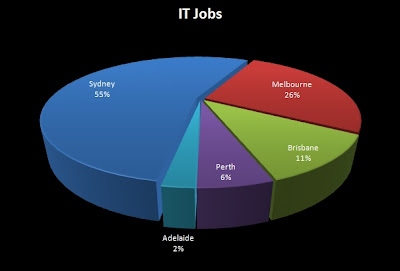
データ元:http://www.seek.com.au/it-jobs/
Sydney…7624件 Melbourne…3652件 Brisbane…1576件 Perth…787件 Adelaide…338件
(From 海外フォーラム)

データ元:http://www.seek.com.au/it-jobs/
Sydney…7624件 Melbourne…3652件 Brisbane…1576件 Perth…787件 Adelaide…338件
(From 海外フォーラム)
The Best Answers toTough Interview Questions
- 16:51
- Write comment
転載
Tell me aboutyourself.
This is really more of a request than a question. But these few words can put you on the spot in a way no question can. Many quickly lose control of the interview during the most critical time- the first five minutes.This is not the time to go into a lengthy history or wander off in different directions. Your response should be focused and purposeful. Communicate a pattern of interests and skills that relate to the position in question. Consider your response to this question as a commercial that sells your autobiography.Provide an answer that includes in formation about where you grew up, where you went to school, your initial work experience, additional education and special training, where you are now, and what you intend to do next. One of the most effective ways to prepare for this question is to develop a 60-second biographic sketch that emphasizes a pattern of interests, skills, and accomplishments. Focus your response around a common theme related to your major interests and skills. Take, for example, the following response, which emphasizes computers.
"I was born in Canton, Ohio and attended Lincoln High School. Ever since I was a teenager, I tinkered with computers. It was my hobby, my passion, and my way of learning. Like most kids I enjoyed computer games. When my folks gave me a computer as a reward for making honor roll mysophomore year, I mastered DOS, Windows, and WordPerfect within six months. I then went on to teach myself programming basics.
By the time I graduated high school, I knew I wanted to study programming. From that point on, everything fell into place. My life revolved around computing.By my junior year at Syracuse, I decided I wanted to work for a major software manufacturer. That is why I had an internship last summer at FastTrack Software.
I now want to work for a major player so I can be at the forefront of breaking trends and new technology. When my college roommate told me about his start in your department, I hounded him until he helped me get a referral, which brought me here today.
I am prepared to answer any questions you may have about my education and experience."
This response sets a nice tone for starting the interview.The interviewee is able to say a lot within 60 seconds by staying focused. The message is clear: the interviewee has both passion and focus relating to the position. He stays on message and concludes by leaving the door open for additional questions about his education and experience. Unfortunately some candidates get off on the wrong foot by rambling on for several minutes about their childhood, family, hobbies, travels, and interests.
Repeat Key Accomplishment Statements
Throughout the interview you will be asked numerous questions about your attitude and ability to do the job. Whenever possible, talk about your accomplishments in terms of what you did and the results of your actions for employers. Give examples of your effectiveness, which should include specific skills and statistics.
Where do you seey ourself five years from now?
This open-ended question is one of the most difficult and stressful ones job seekers face. Employers ostensibly ask this question because they are looking for people who know what they want to do and who are focused on specific professional goals. If you lack goals, you will have difficulty answering this question. Be sure you arrive at the interview with a clear vision of what you want to do today, tomorrow and five years from now. Be consistent with the objective on your resume and the skills and accomplishments you're communicating to the interviewer. Your answer should be employer-centered. For example,
"In five years Ihope to be working with an employer in an increasingly responsible position,that enables me to utilize my talents and work closely with my colleagues insolving important problems. I see myself taking on new and exciting challengesin an enjoyable environment and hopefully this will be with your company."
Do not indicate that you hope to start your own business,change careers, or go back to school. Such responses indicate a lack oflong-term interest since you do not plan to be around for long. While some may respond that they honestly haven't really thought that far ahead, the interviewer infers that the applicant lacks vision and goals.
Describe a major goal you've set for yourself recently.
Give an example of a goal you both set and achieved.I deally, this should be a professional goal; such as improved time managements kills, achieved new performance targets, or learned a new skill. A personal example can also be appropriate if it reinforces your pattern of accomplishments. For example, if you take a great deal of initiative and quickly move into leadership positions, you might use a personal example relating to your recent community work: organized a community walk-a-thon that raised $30,000 in matching funds to purchase new computers for the local library. Talk about results of achieving your goal. This indicates you set realistic goals and that you can focus on outcomes. Select an example that has interesting outcomes related to your efforts. The example should showcase your skills and abilities.
Now that you've had a chance to learn more about us, what would you change about our company?
Be careful here. Most companies don't want you to come in and shake up the place. At the same time, they don't want someone who says,"Nothing, everything looks great here." Seek a middle ground by focusing on one or two non-threatening issues that may have come up in your discussions. For example,
"From our discussion of the problem with the southwest accounts, I think we should look into the possibility of consolidating them the LA office. However, I think we need to do a thorough cost-benefit analysis of this region before making such a move. We may find the Phoenix office to be more beneficial."
Such an answer indicates you are open to making changes but you also have a certain non-threatening decision-making style. Your response should sound sensible and innovative.
We all have weaknesses. What are some of your major weaknesses?
This is not the time to confess all your problems nor to confidently say you have no weaknesses. The best way to handle this question is to mention personal weaknesses that are outside the job or a professional weakness that you have already improved upon. For example,
"I have a rea lweakness for chocolate that tends to go right to my waist! I'm watching my calories carefully these days!" or "I've never been good with accounting. I'm glad this job doesn't involve accounting." Or "I havea tendency to take on too much on my own. I am working on this by delegating more."
What type of decisions do you have difficulty making?
Show that you are generally decisive but mention that there are situations that give you time to pause or you are learning how to better make decisions. For example,
"I sometimes have difficulty choosing between two equally good ideas." or "I used to have difficulty saying 'no' to people until I learned to better set priorities."
What is your biggest failure?
Focus on something outside your work or something that happened on the job that you later fixed. Do not admit to any personal quality that might hamper job performance, such as procrastination, laziness or lack ofconcentration. Choose something that will not reflect badly on your ability to perform in the given position, such as one that took place early in your career. For example,
"My biggest failure was not being selected as a SEAL because I was diagnosed with nightvision problems. When I was 18, all I wanted to be was a SEAL. But I'm glad I didn't, because I may have overlooked an exciting career in informationtechnology" or "When I was working at CL Advertising Associates, Ilost the $2 million Jettler account after only six weeks on the job! I felt awful and thought I would be fired. I was determined to get the account back and did after six months. Today the account makes up 1/3 of CL Advertising."
What are the major reasons for your success?
This is not the time to become extremely self-centered and arrogant. Keep in mind that employers are often looking for team players rather than Lone Rangers. A good response to this question may relate to a mentor/andor philosophy of work or the people you work with. Also, use this question as an opportunity to inquire about an appropriate "fit for success" with this company. For example,
"Many years ago I learned an important lesson from Bob Nelson, who was my first supervisor and really became my most important mentor. He told me his secret to success was to'Look at each day as a new opportunity to be your very best. Set high goals, behonest, never say no, and work with people who share your passion for doing their best.' I've always remembered that advice and try to live it every day. Iam very self motivated, determined and honest. I really love what I do and I try to surround myself with people who share similar passions. I thrive on this type of environment. Am I likely to find this environment with your company?Can you tell me a little more about the characteristics of successful people atyour company? What do you see as some of the key success factors for this position?"
We're considering two other candidates for this position. Why should we hire you rather than someone else?
Do not be distracted by the mention of two other candidates,you don't know anything about them and they could be fictitious. Focus on what strengths you bring to the table. These should be consistent with the four things most employers are looking for in candidates during the job interview:competence, professionalism, enthusiasm, and likability. Remember, they are looking for chemistry between you and them. Be prepared to summarize in 60 seconds why you are the best candidate for the job. Also, let the employer know you want the job and you will enjoy working with them. A lack of interest in the job may indicate a lack of enthusiasm for the job and them.
How do you spend your free time?
This question may have several purposes. The interviewer maybe just curious about your personal life without getting into illegal questions. He may also want to know how well rounded you are in your personal and professional lives. Focus on some of the standard hobbies or activitiesthat most people engage in: golf, tennis, boating, reading, music, opera,collecting, gardening, or cooking. If you are operating a home-based businessas a sideline, you may not want to reveal your entrepreneurial spirit-it may indicate you are planning to leave and go solo as soon as the business starts doing well.
Why do you want to work in this industry?
Tell a story about how you first became interested in this type of work. Point out any similarities between the job you're interviewing for and your current or most recent job. Provide proof that you aren't simply shopping in this interview. Make your passions for you work a theme that you allude to continually throughout the interview.
"I've always wanted to work in an industry that makes tools. One of my hobbies ishome-improvement projects, so I've collected a number of saws manufactured by your company. I could be an accountant anywhere, but I'd rather work for acompany whose products I trust."
How do you stay current?
Demonstrate natural interest in the industry or career field by describing publications or trade associations that are compatible with your goal.
"I pore over the Wall Street Journal, the Times, Institutional Investor, and several mutual fundnewsletters. And I have a number of friends who are analysts."
Why do you think this industry would sustain your interest in the long haul?
What expectations or projects do you have for the business that would enable you to grow without necessarily advancing? What excites you about the business? What proof can you offer that your interest has already come from a deep curiosity-perhaps going back at least a few years-rather thana current whim you'll outgrow?
"The technology in the industry is changing so rapidly that I see lots of room for job enhancement regardless of promotions. I'm particularly interested in the many applications for multimedia as a training tool."
Where do you want to be in five years?
Don't give specific time frames or job titles. Talk about what you enjoy, skills that are natural to you, realistic problems or opportunities you'd expect in your chosen field or industry, and what you hope to learn from those experiences. You shouldn't discuss your goals in a fields or industry unrelated to the job you're applying for. This may sound obvious,but too many candidates make this mistake, unwittingly demonstrating a real lack of interest in their current field or industry. Needless to say, such a gaffe will immediately eliminate you from further consideration.
"I'd like to have the opportunity to work in a plant as well as at the home office. I also hope to develop my management skills, perhaps by managing a small staff."
Describe your ideal career.
Talk about what you enjoy, skills that are natural to you,realistic problems or opportunities you'd expect in this particular job or industry, and what you hope to learn from those experiences. Avoid mentioning specific time frames or job titles.
"I'd like to stay in a field related to training no matter what happens. I was too interested in business to work at a university, but I believe that teaching is somehow in my blood. I've been good at sales because I took the time to educate my clients.Now I look forward to training the new hires."
Tell me something about yourself that I didn't know from reading your resume.
Don't just repeat what's on your resume. Think of a talentor skill that didn't quite fit into your employment history, but that's uniqueand reveals something intriguing about your personality or past experience.
"You wouldn't know that I've managed my own small portfolio since I was sixteen, but I believe that it's important for you to understand my interest in investment sales. I've averaged a 12 percent return over the past eight years."
Tell me what you know about this company.
Describe your first encounter or a recent encounter with the company or its products and services. What would be particularly motivating to you about working there as opposed to working the same type of job in a different company? The recruiter will look for evidence of genuine interest and more than just surface research on the company. Reciting the annual report isn't likely to impress most recruiters, but feedback from customers and employees will.
"I served as an intern to a restaurant analyst last summer, so I followed all the steak-house chains closely. What you've done especially well is focus on a limited menu with great consistency among locations; the business traveler trusts your product anywhere in the U.S. I'm particularly interested in your real-estate finance group and expansion plans."
What have you learne dabout our company from customers, employees, or others?
Describe how your interest has grown from personal dealings with the company representatives. Think creatively in preparing for job interviews. For example, prior to your job interview, speak with retailers orworkers at other distribution points about the company's product line. What can they tell you? Give one or two examples of what you've learned to explain why you're interested in this company. What's the most compelling example you can describe to prove your interest?
"I actually called several of the key accountants mentioned in your brochure. Two of the customers I spoke with explained why they continued to buy from you year after year. Your distribution operation is phenomenal. Are there any service improvements youthink could still be made?"
Tell me what you think our distinctive advantage is within the industry.
Describe things you believe the company does very well,particularly compared to its competition. Explain how the financial strength ofthe company is important.
"With your low-cost-producer status and headquarters operation in a low-cost area of thecountry, you seem in a better position to be able to spend aggressively on R&D, even in a down year compared to your closest rival."
What other firms are you interviewing with, and for what positions?
Often the candidate will try to impress the employer by naming some large firms in unrelated industries with completely different types of jobs. This is a big mistake! What employers want to hear is that you're interviewing for similar jobs in the same industry at similar firms (such as their competitors). This illustrates that you're committed to finding a job in your field of interest and are likely to be a low-risk hire.
"Actually, I've definitely decided to pursue a career as a restaurant manager, so I'm applying for restaurant management-training programs. I've recently had interviews withs everal other large national fast-food chains, such as Super Burger and Clackey's Chicken."
Do you believe you're overqualified for this position?
Most people don't expect to be asked if they have a greatdeal of experience. This question could quite easily catch a candidate offguard, which is exactly the interviewer's intention. The candidate doesn't hesitate in answering this question and shows complete confidence in his or herability.
"Not at all. My experience and qualifications make me do my job only better, and in my opinion,my good design skills help to sell more books. My business experience helps me run the art department in a cost-efficient manner, thus saving the company money. Finally, I think I'm able to attract better freelance talent because of all my industry contacts. My qualifications are better for your company, too,since you'll be getting a better return for your investment. Again, I'm interested in establishing a long-term relationship with my employer, and if I did well, I would expect expanded responsibilities that could make use of even other skills."
What would you do if one of our competitors offered you a position?
The interviewer is trying to determine whether the candidateis truly interested in the industry and company, or whether he or she has chosen the company randomly. Contrast your perceptions of the company with its competitors, and talk about the company's products or services that you've encountered. In the long run, which players do you believe are most viable and why? This is also a good place to ask the interviewer for his or her opinion.
"I'd say no. I'm not interested in other players in this industry. I want to work for Nike because I won a number of races wearing the Nike brand. Because of my positive experience with Nike, I know I'd be convincing selling your product toretailers."
What's your dream job?
This is your ideal chance to sell your aptitudes that fit the job description. Show an interest in finding new ways these skills can be put to use in a new job with additional responsibilities. Tie in the industry,size of company, or other factors where appropriate.
"My dream job would include all of the responsibilities and duties in this position you'retrying to fill. I also thrive in a fast-changing environment where there'sbusiness growth. Your plans call for expanding internationally during the nextyear, and this would satisfy one of my ultimate goals of being involved in aninternational corporation."
What motivates you to do this kind of work?
The interviewer will want to know about your belief in the products or services of the company. Use personal experience to demonstrate your interests and strengths. In an interview for your ideal job, you'd be highly motivated to get paid for working at something you liked. The interviewer will want to know if your natural interests are compatible with its particular job.
"I've been fortunate in my own schooling; I had wonderful teachers. I want to be that same kind of teacher-who not only encourages kids to learn but also sets an example that inspires others to want to teach. In the long run, that's our best chance of turning around the quality of education in this state."
Why should I hire you?
Don't repeat your resume or employment history. Offer one or two examples to explain why you're talking to this particular company. What's the most compelling example you can give to prove your interest? This question often remains unasked, but it's always in the back of the recruiter's mind.Even if this question isn't asked, you should find an opportunity to use your prepared response sometime during the interview, perhaps in your closingremarks.
"My uncle had acompany that was a small-scale manufacturer in the industry, and although helater sold the business, I worked there for five summers doing all sorts of oddjobs. For that reason I believe I know this business from the ground up, and you can be assured that I know what I'd be getting into as a plant managerhere."
What are your strengths?
Describe two or three skills you have that are most relevant to the job. Avoid clich
-------------------------------------------------------------------
【回答例】
Can you tell me a little more about the Canto project that you did at ABC Incorporated?
Oh, that was a very exciting project. We had to increase sales by 40% during the 2nd quarter, and our results exceeded expectations,even though we were under a lot of pressure.
Why should I hire you?
I feel that my qualifications match your job description. I have a proven track record in resolving problems, multitasking, and dealing with customers, as you can see from my resume.
What can you offer this company?
In addition to the skills and experience we discussed, I’m an extremely hard worker, I’m very thorough and methodical, I get along great with people, and I’m a quick learner.
Can you tell me some of your strengths and weaknesses?
I’m loyal, honest, I manage my time effectively, I always follow through on my work, and I have great computer skills. Umm, I can’t really say I have any major weakness that affects my performance at work. I believe in continual learning and on-the-job training so that I can perform even better. Sometimes, I think I’m too hard-working, but I really love my work.
Great! So when can you start?
I have to give two weeks notice, which is just enough time to complete my current project. I can start any time after that.
Tell me aboutyourself.
This is really more of a request than a question. But these few words can put you on the spot in a way no question can. Many quickly lose control of the interview during the most critical time- the first five minutes.This is not the time to go into a lengthy history or wander off in different directions. Your response should be focused and purposeful. Communicate a pattern of interests and skills that relate to the position in question. Consider your response to this question as a commercial that sells your autobiography.Provide an answer that includes in formation about where you grew up, where you went to school, your initial work experience, additional education and special training, where you are now, and what you intend to do next. One of the most effective ways to prepare for this question is to develop a 60-second biographic sketch that emphasizes a pattern of interests, skills, and accomplishments. Focus your response around a common theme related to your major interests and skills. Take, for example, the following response, which emphasizes computers.
"I was born in Canton, Ohio and attended Lincoln High School. Ever since I was a teenager, I tinkered with computers. It was my hobby, my passion, and my way of learning. Like most kids I enjoyed computer games. When my folks gave me a computer as a reward for making honor roll mysophomore year, I mastered DOS, Windows, and WordPerfect within six months. I then went on to teach myself programming basics.
By the time I graduated high school, I knew I wanted to study programming. From that point on, everything fell into place. My life revolved around computing.By my junior year at Syracuse, I decided I wanted to work for a major software manufacturer. That is why I had an internship last summer at FastTrack Software.
I now want to work for a major player so I can be at the forefront of breaking trends and new technology. When my college roommate told me about his start in your department, I hounded him until he helped me get a referral, which brought me here today.
I am prepared to answer any questions you may have about my education and experience."
This response sets a nice tone for starting the interview.The interviewee is able to say a lot within 60 seconds by staying focused. The message is clear: the interviewee has both passion and focus relating to the position. He stays on message and concludes by leaving the door open for additional questions about his education and experience. Unfortunately some candidates get off on the wrong foot by rambling on for several minutes about their childhood, family, hobbies, travels, and interests.
Repeat Key Accomplishment Statements
Throughout the interview you will be asked numerous questions about your attitude and ability to do the job. Whenever possible, talk about your accomplishments in terms of what you did and the results of your actions for employers. Give examples of your effectiveness, which should include specific skills and statistics.
Where do you seey ourself five years from now?
This open-ended question is one of the most difficult and stressful ones job seekers face. Employers ostensibly ask this question because they are looking for people who know what they want to do and who are focused on specific professional goals. If you lack goals, you will have difficulty answering this question. Be sure you arrive at the interview with a clear vision of what you want to do today, tomorrow and five years from now. Be consistent with the objective on your resume and the skills and accomplishments you're communicating to the interviewer. Your answer should be employer-centered. For example,
"In five years Ihope to be working with an employer in an increasingly responsible position,that enables me to utilize my talents and work closely with my colleagues insolving important problems. I see myself taking on new and exciting challengesin an enjoyable environment and hopefully this will be with your company."
Do not indicate that you hope to start your own business,change careers, or go back to school. Such responses indicate a lack oflong-term interest since you do not plan to be around for long. While some may respond that they honestly haven't really thought that far ahead, the interviewer infers that the applicant lacks vision and goals.
Describe a major goal you've set for yourself recently.
Give an example of a goal you both set and achieved.I deally, this should be a professional goal; such as improved time managements kills, achieved new performance targets, or learned a new skill. A personal example can also be appropriate if it reinforces your pattern of accomplishments. For example, if you take a great deal of initiative and quickly move into leadership positions, you might use a personal example relating to your recent community work: organized a community walk-a-thon that raised $30,000 in matching funds to purchase new computers for the local library. Talk about results of achieving your goal. This indicates you set realistic goals and that you can focus on outcomes. Select an example that has interesting outcomes related to your efforts. The example should showcase your skills and abilities.
Now that you've had a chance to learn more about us, what would you change about our company?
Be careful here. Most companies don't want you to come in and shake up the place. At the same time, they don't want someone who says,"Nothing, everything looks great here." Seek a middle ground by focusing on one or two non-threatening issues that may have come up in your discussions. For example,
"From our discussion of the problem with the southwest accounts, I think we should look into the possibility of consolidating them the LA office. However, I think we need to do a thorough cost-benefit analysis of this region before making such a move. We may find the Phoenix office to be more beneficial."
Such an answer indicates you are open to making changes but you also have a certain non-threatening decision-making style. Your response should sound sensible and innovative.
We all have weaknesses. What are some of your major weaknesses?
This is not the time to confess all your problems nor to confidently say you have no weaknesses. The best way to handle this question is to mention personal weaknesses that are outside the job or a professional weakness that you have already improved upon. For example,
"I have a rea lweakness for chocolate that tends to go right to my waist! I'm watching my calories carefully these days!" or "I've never been good with accounting. I'm glad this job doesn't involve accounting." Or "I havea tendency to take on too much on my own. I am working on this by delegating more."
What type of decisions do you have difficulty making?
Show that you are generally decisive but mention that there are situations that give you time to pause or you are learning how to better make decisions. For example,
"I sometimes have difficulty choosing between two equally good ideas." or "I used to have difficulty saying 'no' to people until I learned to better set priorities."
What is your biggest failure?
Focus on something outside your work or something that happened on the job that you later fixed. Do not admit to any personal quality that might hamper job performance, such as procrastination, laziness or lack ofconcentration. Choose something that will not reflect badly on your ability to perform in the given position, such as one that took place early in your career. For example,
"My biggest failure was not being selected as a SEAL because I was diagnosed with nightvision problems. When I was 18, all I wanted to be was a SEAL. But I'm glad I didn't, because I may have overlooked an exciting career in informationtechnology" or "When I was working at CL Advertising Associates, Ilost the $2 million Jettler account after only six weeks on the job! I felt awful and thought I would be fired. I was determined to get the account back and did after six months. Today the account makes up 1/3 of CL Advertising."
What are the major reasons for your success?
This is not the time to become extremely self-centered and arrogant. Keep in mind that employers are often looking for team players rather than Lone Rangers. A good response to this question may relate to a mentor/andor philosophy of work or the people you work with. Also, use this question as an opportunity to inquire about an appropriate "fit for success" with this company. For example,
"Many years ago I learned an important lesson from Bob Nelson, who was my first supervisor and really became my most important mentor. He told me his secret to success was to'Look at each day as a new opportunity to be your very best. Set high goals, behonest, never say no, and work with people who share your passion for doing their best.' I've always remembered that advice and try to live it every day. Iam very self motivated, determined and honest. I really love what I do and I try to surround myself with people who share similar passions. I thrive on this type of environment. Am I likely to find this environment with your company?Can you tell me a little more about the characteristics of successful people atyour company? What do you see as some of the key success factors for this position?"
We're considering two other candidates for this position. Why should we hire you rather than someone else?
Do not be distracted by the mention of two other candidates,you don't know anything about them and they could be fictitious. Focus on what strengths you bring to the table. These should be consistent with the four things most employers are looking for in candidates during the job interview:competence, professionalism, enthusiasm, and likability. Remember, they are looking for chemistry between you and them. Be prepared to summarize in 60 seconds why you are the best candidate for the job. Also, let the employer know you want the job and you will enjoy working with them. A lack of interest in the job may indicate a lack of enthusiasm for the job and them.
How do you spend your free time?
This question may have several purposes. The interviewer maybe just curious about your personal life without getting into illegal questions. He may also want to know how well rounded you are in your personal and professional lives. Focus on some of the standard hobbies or activitiesthat most people engage in: golf, tennis, boating, reading, music, opera,collecting, gardening, or cooking. If you are operating a home-based businessas a sideline, you may not want to reveal your entrepreneurial spirit-it may indicate you are planning to leave and go solo as soon as the business starts doing well.
Why do you want to work in this industry?
Tell a story about how you first became interested in this type of work. Point out any similarities between the job you're interviewing for and your current or most recent job. Provide proof that you aren't simply shopping in this interview. Make your passions for you work a theme that you allude to continually throughout the interview.
"I've always wanted to work in an industry that makes tools. One of my hobbies ishome-improvement projects, so I've collected a number of saws manufactured by your company. I could be an accountant anywhere, but I'd rather work for acompany whose products I trust."
How do you stay current?
Demonstrate natural interest in the industry or career field by describing publications or trade associations that are compatible with your goal.
"I pore over the Wall Street Journal, the Times, Institutional Investor, and several mutual fundnewsletters. And I have a number of friends who are analysts."
Why do you think this industry would sustain your interest in the long haul?
What expectations or projects do you have for the business that would enable you to grow without necessarily advancing? What excites you about the business? What proof can you offer that your interest has already come from a deep curiosity-perhaps going back at least a few years-rather thana current whim you'll outgrow?
"The technology in the industry is changing so rapidly that I see lots of room for job enhancement regardless of promotions. I'm particularly interested in the many applications for multimedia as a training tool."
Where do you want to be in five years?
Don't give specific time frames or job titles. Talk about what you enjoy, skills that are natural to you, realistic problems or opportunities you'd expect in your chosen field or industry, and what you hope to learn from those experiences. You shouldn't discuss your goals in a fields or industry unrelated to the job you're applying for. This may sound obvious,but too many candidates make this mistake, unwittingly demonstrating a real lack of interest in their current field or industry. Needless to say, such a gaffe will immediately eliminate you from further consideration.
"I'd like to have the opportunity to work in a plant as well as at the home office. I also hope to develop my management skills, perhaps by managing a small staff."
Describe your ideal career.
Talk about what you enjoy, skills that are natural to you,realistic problems or opportunities you'd expect in this particular job or industry, and what you hope to learn from those experiences. Avoid mentioning specific time frames or job titles.
"I'd like to stay in a field related to training no matter what happens. I was too interested in business to work at a university, but I believe that teaching is somehow in my blood. I've been good at sales because I took the time to educate my clients.Now I look forward to training the new hires."
Tell me something about yourself that I didn't know from reading your resume.
Don't just repeat what's on your resume. Think of a talentor skill that didn't quite fit into your employment history, but that's uniqueand reveals something intriguing about your personality or past experience.
"You wouldn't know that I've managed my own small portfolio since I was sixteen, but I believe that it's important for you to understand my interest in investment sales. I've averaged a 12 percent return over the past eight years."
Tell me what you know about this company.
Describe your first encounter or a recent encounter with the company or its products and services. What would be particularly motivating to you about working there as opposed to working the same type of job in a different company? The recruiter will look for evidence of genuine interest and more than just surface research on the company. Reciting the annual report isn't likely to impress most recruiters, but feedback from customers and employees will.
"I served as an intern to a restaurant analyst last summer, so I followed all the steak-house chains closely. What you've done especially well is focus on a limited menu with great consistency among locations; the business traveler trusts your product anywhere in the U.S. I'm particularly interested in your real-estate finance group and expansion plans."
What have you learne dabout our company from customers, employees, or others?
Describe how your interest has grown from personal dealings with the company representatives. Think creatively in preparing for job interviews. For example, prior to your job interview, speak with retailers orworkers at other distribution points about the company's product line. What can they tell you? Give one or two examples of what you've learned to explain why you're interested in this company. What's the most compelling example you can describe to prove your interest?
"I actually called several of the key accountants mentioned in your brochure. Two of the customers I spoke with explained why they continued to buy from you year after year. Your distribution operation is phenomenal. Are there any service improvements youthink could still be made?"
Tell me what you think our distinctive advantage is within the industry.
Describe things you believe the company does very well,particularly compared to its competition. Explain how the financial strength ofthe company is important.
"With your low-cost-producer status and headquarters operation in a low-cost area of thecountry, you seem in a better position to be able to spend aggressively on R&D, even in a down year compared to your closest rival."
What other firms are you interviewing with, and for what positions?
Often the candidate will try to impress the employer by naming some large firms in unrelated industries with completely different types of jobs. This is a big mistake! What employers want to hear is that you're interviewing for similar jobs in the same industry at similar firms (such as their competitors). This illustrates that you're committed to finding a job in your field of interest and are likely to be a low-risk hire.
"Actually, I've definitely decided to pursue a career as a restaurant manager, so I'm applying for restaurant management-training programs. I've recently had interviews withs everal other large national fast-food chains, such as Super Burger and Clackey's Chicken."
Do you believe you're overqualified for this position?
Most people don't expect to be asked if they have a greatdeal of experience. This question could quite easily catch a candidate offguard, which is exactly the interviewer's intention. The candidate doesn't hesitate in answering this question and shows complete confidence in his or herability.
"Not at all. My experience and qualifications make me do my job only better, and in my opinion,my good design skills help to sell more books. My business experience helps me run the art department in a cost-efficient manner, thus saving the company money. Finally, I think I'm able to attract better freelance talent because of all my industry contacts. My qualifications are better for your company, too,since you'll be getting a better return for your investment. Again, I'm interested in establishing a long-term relationship with my employer, and if I did well, I would expect expanded responsibilities that could make use of even other skills."
What would you do if one of our competitors offered you a position?
The interviewer is trying to determine whether the candidateis truly interested in the industry and company, or whether he or she has chosen the company randomly. Contrast your perceptions of the company with its competitors, and talk about the company's products or services that you've encountered. In the long run, which players do you believe are most viable and why? This is also a good place to ask the interviewer for his or her opinion.
"I'd say no. I'm not interested in other players in this industry. I want to work for Nike because I won a number of races wearing the Nike brand. Because of my positive experience with Nike, I know I'd be convincing selling your product toretailers."
What's your dream job?
This is your ideal chance to sell your aptitudes that fit the job description. Show an interest in finding new ways these skills can be put to use in a new job with additional responsibilities. Tie in the industry,size of company, or other factors where appropriate.
"My dream job would include all of the responsibilities and duties in this position you'retrying to fill. I also thrive in a fast-changing environment where there'sbusiness growth. Your plans call for expanding internationally during the nextyear, and this would satisfy one of my ultimate goals of being involved in aninternational corporation."
What motivates you to do this kind of work?
The interviewer will want to know about your belief in the products or services of the company. Use personal experience to demonstrate your interests and strengths. In an interview for your ideal job, you'd be highly motivated to get paid for working at something you liked. The interviewer will want to know if your natural interests are compatible with its particular job.
"I've been fortunate in my own schooling; I had wonderful teachers. I want to be that same kind of teacher-who not only encourages kids to learn but also sets an example that inspires others to want to teach. In the long run, that's our best chance of turning around the quality of education in this state."
Why should I hire you?
Don't repeat your resume or employment history. Offer one or two examples to explain why you're talking to this particular company. What's the most compelling example you can give to prove your interest? This question often remains unasked, but it's always in the back of the recruiter's mind.Even if this question isn't asked, you should find an opportunity to use your prepared response sometime during the interview, perhaps in your closingremarks.
"My uncle had acompany that was a small-scale manufacturer in the industry, and although helater sold the business, I worked there for five summers doing all sorts of oddjobs. For that reason I believe I know this business from the ground up, and you can be assured that I know what I'd be getting into as a plant managerhere."
What are your strengths?
Describe two or three skills you have that are most relevant to the job. Avoid clich
-------------------------------------------------------------------
【回答例】
Can you tell me a little more about the Canto project that you did at ABC Incorporated?
Oh, that was a very exciting project. We had to increase sales by 40% during the 2nd quarter, and our results exceeded expectations,even though we were under a lot of pressure.
Why should I hire you?
I feel that my qualifications match your job description. I have a proven track record in resolving problems, multitasking, and dealing with customers, as you can see from my resume.
What can you offer this company?
In addition to the skills and experience we discussed, I’m an extremely hard worker, I’m very thorough and methodical, I get along great with people, and I’m a quick learner.
Can you tell me some of your strengths and weaknesses?
I’m loyal, honest, I manage my time effectively, I always follow through on my work, and I have great computer skills. Umm, I can’t really say I have any major weakness that affects my performance at work. I believe in continual learning and on-the-job training so that I can perform even better. Sometimes, I think I’m too hard-working, but I really love my work.
Great! So when can you start?
I have to give two weeks notice, which is just enough time to complete my current project. I can start any time after that.
How to find job in Australia
- 22:07
- Write comment
転載。
I immigrated to Australia few months back. I was armed with an IIT degree with 4 year exp in world class company in India. Looked on-line for various tactics to get job quickly and implemented most of what I found logical. With substantial effort and hard work i finally managed to get a job. This page is an extract of my experience during my struggle which I found the hard way so that others would streamline their efforts and get job quickly.
How Long is too long: My first week resulted in 2 interview and the requirement was so close i believed i was too unlucky to not get in one of them. I was on high and thought it would be cakewalk. Soon reality strikes and i entered in dry period with nothing happening for next 3 weeks. I talked to many seasoned people and they helped me to calm down. I was told if someone migrating to au gets first job in 2 month, his lucky star is shinning very very bright. Typicall time is from 2 month to 6 month. You would be very unlucky not to find anything even struggling for six months.
One Lingering Curiosity: First lets clear one curiosity which comes to all of our minds. Can one find job sitting back in home country ?When I tried searching sitting back in india I must admit the response was poor. Few bothered to reply back with standard regret mail. Very few recruiters do reply back that they would consider if i were in Au. After i arrived, i had opportunity to talk to many recruiters face to face and asked if its possible to consider for position sitting back in home country. Unless the requirement is really unique the company would easily find the skill set in the present market and would not consider going for visa delays and hassles. With global financial crisis , the chances of securing job sitting in homeland is virtually impossible in my view.
Job Market Dynamics: Let me first give you a brief insight how things work here. Here in Au most of the jobs are advertised by recruiting agencies who are hired by companies to find suitable candidates. These agencies post job ads to various sites and in response gets tons of resumes. The recruiters put email filters so that only resume with most matching keywords pass their mailbox. Then recruiters scan all resumes in mailbox and most of the time submit just 1-2 resumes to company for considerations. Usually one company give request to 3-4 recruiting agency hence these agencies are competing for the commission for this one job. Now understand the dynamics here. The recruiter has only 1-2 resume which he can submit from the whole lot and he can maximize his chance of securing the commission only if he presents the very best talents to company. Hence the first and the biggest hurdle in securing job is convincing the recruiting agency that you are the best talent available for this position and if he gets any doubt on your credentials then your resume is heading to his bin.
Contact Recruiting Agency: If the resume is a great match to the opening its highly recommended to call the recruiter after submitting resume. The recruiter would honestly convey why he feel you are not the best option for this role and you have a chance to clarify anything if the resume is not highlighting it properly. If he buys your explanation then its better to ask for the exact requirement and resend another tailor made resume highlighting in CV the exp and achievement in-line with the requirements. Recruiters prefer to meet the candidate to ensure whom they are presenting to the hiring manager. If he asks to meet, you should gladly agree and try to fix appointment at earliest. If recruiter do not follow you for this opening in future, its better not to worry bcos the job has already slipped out of your hand so fetch another rather than going for wild goose chase. Tailored resume highlighting requirements is very important. Since most of the openings are contract based companies dont hire anyone who has learning curve. Even if the recruiter dont budge after you call, its wise to politely exit the call and try to bridge good relation with the recruiter so that you are considered for future prospects. Out of 100 applicants he rejects 98 so Always remember he may be your biggest hurdle but he can be your stepping stone if he believes you and short list you.
Local Experience: One thing I heard quite frequently is called 'local experience'. This one word will hurt your prospects more often then not. There are many reasons for giving significance to local experience. Few recruiters says its easy to check references if one has local experience. Candidates under sheer desperation to get any job go in length to tailor resume which they cant defend in interview and waste everyone time. Remember tailoring is highlighting your skills relevant to requirement and would certainly help but fake resume wont. With local exp one can be sure to be able to work with the team in au and has adopted to the aussie work culture. I personally believe the arguments for local exp are weak and unfair but who says life is always fair.
Finance Matters: The most important thing to consider before landing is finance. Its the most important thing bcos Sydney/Melbourne are quite expensive. I was told by many that you should have finance to servive in Au for atleast 6 months. Me and my wife were spending wisely still the expenses were huge . Few tactics I believe one should adopt initially:
1. If possible dont come with family. If you come alone the cost of living can be reduced by sharing apartment etc.
2. Visit few sites to get idea of how and where to find accommodation
3. Staying initially with friend/relative is wise before you know how things work
4. Internet and telephone is required for finding job so account for a laptop and USB internet connection
5. Public transport is reasonable but dont even dare to walk into cabs . They leave a big hole in pocket.
Voluntary and honorary options: Try to find if someone can give you honorary job which gives you experience rather then sitting at home. One should be intellegent to fish at the right place. A software programmer with 5 year of exp will not be gaining anything by working as unpaid sales man for garments shop but would be helped if he is selling some software. Find hard and convince your employer(very difficult) you would not run as soon as you find something
Communication: There is great importance given to communication. The candidate should be filled with confidence. The hand shake should be firm and confident contact to eye is required. I personally believe there is little place for politeness and humbleness when you come for interview. Dont get me wrong. Aussies are one of the most polite and courtiers people but hiring manager want to see confidence on the face of candidate( dont mix with arrogance). I would highly recommend practising commonly asked questions to avoid any pitfalls.
Resume Building: Your resume is the biggest weapon in your bag. Use it wisely. For first job its highly recommended the resume is detailed. The details are required so that there are less queries during interview. Being the first job, one may not know the best way to answer so the lesser questions are preferred so put as much detail as you can. Here is a catch. Put all details but nothing which wastes readers time as time is very highly regarded here.
Applying for Job: When you land in oz, everyone would give you their own idea on how to apply and search for job. Few people told me to apply for each and every job you see on-line even if you dont have any relevant experience. It may sound crazy but it makes sense. The resume may reach the recruiting agency (if passed email filter) and he may consider it for future. But there again is a catch. If you overdo it it may irritate recruiter, he may think you dont understand the stuff you are talking and worst he may block your incoming mails. Remember you are wasting his time and for him time is directly proportional to money. I myself overdid it and got the response from one " I read your resume carefully and found NONE of the requirement matching. " Finally I decided to put all my efforts to the few for which I am good.
Networking Sites: I believe networking through linkedin, facebook, orkut etc is the best way to get first job in oz. Recruiters obviously prefer those with local experience and they usually have openings which are for senior positions. Companies usually consider immigrants for junior positions and once the ability of person is proven he moves up the ladder. Unfortunately junior positions are not advertized since the company prefer not to spent money for junior positions and to fill it internally through reference. Thats where networking is so important. It takes a while to build a working network in foreign land so one should have patience and dedication for networking.
Above are the gist of experience I earned during my job search. I dont claim they are the best but i believe they work . If someone needs more information on any point, i didnt covered in detail, they are welcome to leave a comment. All the best to all aspiring minds for their future endeavours.
I immigrated to Australia few months back. I was armed with an IIT degree with 4 year exp in world class company in India. Looked on-line for various tactics to get job quickly and implemented most of what I found logical. With substantial effort and hard work i finally managed to get a job. This page is an extract of my experience during my struggle which I found the hard way so that others would streamline their efforts and get job quickly.
How Long is too long: My first week resulted in 2 interview and the requirement was so close i believed i was too unlucky to not get in one of them. I was on high and thought it would be cakewalk. Soon reality strikes and i entered in dry period with nothing happening for next 3 weeks. I talked to many seasoned people and they helped me to calm down. I was told if someone migrating to au gets first job in 2 month, his lucky star is shinning very very bright. Typicall time is from 2 month to 6 month. You would be very unlucky not to find anything even struggling for six months.
One Lingering Curiosity: First lets clear one curiosity which comes to all of our minds. Can one find job sitting back in home country ?When I tried searching sitting back in india I must admit the response was poor. Few bothered to reply back with standard regret mail. Very few recruiters do reply back that they would consider if i were in Au. After i arrived, i had opportunity to talk to many recruiters face to face and asked if its possible to consider for position sitting back in home country. Unless the requirement is really unique the company would easily find the skill set in the present market and would not consider going for visa delays and hassles. With global financial crisis , the chances of securing job sitting in homeland is virtually impossible in my view.
Job Market Dynamics: Let me first give you a brief insight how things work here. Here in Au most of the jobs are advertised by recruiting agencies who are hired by companies to find suitable candidates. These agencies post job ads to various sites and in response gets tons of resumes. The recruiters put email filters so that only resume with most matching keywords pass their mailbox. Then recruiters scan all resumes in mailbox and most of the time submit just 1-2 resumes to company for considerations. Usually one company give request to 3-4 recruiting agency hence these agencies are competing for the commission for this one job. Now understand the dynamics here. The recruiter has only 1-2 resume which he can submit from the whole lot and he can maximize his chance of securing the commission only if he presents the very best talents to company. Hence the first and the biggest hurdle in securing job is convincing the recruiting agency that you are the best talent available for this position and if he gets any doubt on your credentials then your resume is heading to his bin.
Contact Recruiting Agency: If the resume is a great match to the opening its highly recommended to call the recruiter after submitting resume. The recruiter would honestly convey why he feel you are not the best option for this role and you have a chance to clarify anything if the resume is not highlighting it properly. If he buys your explanation then its better to ask for the exact requirement and resend another tailor made resume highlighting in CV the exp and achievement in-line with the requirements. Recruiters prefer to meet the candidate to ensure whom they are presenting to the hiring manager. If he asks to meet, you should gladly agree and try to fix appointment at earliest. If recruiter do not follow you for this opening in future, its better not to worry bcos the job has already slipped out of your hand so fetch another rather than going for wild goose chase. Tailored resume highlighting requirements is very important. Since most of the openings are contract based companies dont hire anyone who has learning curve. Even if the recruiter dont budge after you call, its wise to politely exit the call and try to bridge good relation with the recruiter so that you are considered for future prospects. Out of 100 applicants he rejects 98 so Always remember he may be your biggest hurdle but he can be your stepping stone if he believes you and short list you.
Local Experience: One thing I heard quite frequently is called 'local experience'. This one word will hurt your prospects more often then not. There are many reasons for giving significance to local experience. Few recruiters says its easy to check references if one has local experience. Candidates under sheer desperation to get any job go in length to tailor resume which they cant defend in interview and waste everyone time. Remember tailoring is highlighting your skills relevant to requirement and would certainly help but fake resume wont. With local exp one can be sure to be able to work with the team in au and has adopted to the aussie work culture. I personally believe the arguments for local exp are weak and unfair but who says life is always fair.
Finance Matters: The most important thing to consider before landing is finance. Its the most important thing bcos Sydney/Melbourne are quite expensive. I was told by many that you should have finance to servive in Au for atleast 6 months. Me and my wife were spending wisely still the expenses were huge . Few tactics I believe one should adopt initially:
1. If possible dont come with family. If you come alone the cost of living can be reduced by sharing apartment etc.
2. Visit few sites to get idea of how and where to find accommodation
3. Staying initially with friend/relative is wise before you know how things work
4. Internet and telephone is required for finding job so account for a laptop and USB internet connection
5. Public transport is reasonable but dont even dare to walk into cabs . They leave a big hole in pocket.
Voluntary and honorary options: Try to find if someone can give you honorary job which gives you experience rather then sitting at home. One should be intellegent to fish at the right place. A software programmer with 5 year of exp will not be gaining anything by working as unpaid sales man for garments shop but would be helped if he is selling some software. Find hard and convince your employer(very difficult) you would not run as soon as you find something
Communication: There is great importance given to communication. The candidate should be filled with confidence. The hand shake should be firm and confident contact to eye is required. I personally believe there is little place for politeness and humbleness when you come for interview. Dont get me wrong. Aussies are one of the most polite and courtiers people but hiring manager want to see confidence on the face of candidate( dont mix with arrogance). I would highly recommend practising commonly asked questions to avoid any pitfalls.
Resume Building: Your resume is the biggest weapon in your bag. Use it wisely. For first job its highly recommended the resume is detailed. The details are required so that there are less queries during interview. Being the first job, one may not know the best way to answer so the lesser questions are preferred so put as much detail as you can. Here is a catch. Put all details but nothing which wastes readers time as time is very highly regarded here.
Applying for Job: When you land in oz, everyone would give you their own idea on how to apply and search for job. Few people told me to apply for each and every job you see on-line even if you dont have any relevant experience. It may sound crazy but it makes sense. The resume may reach the recruiting agency (if passed email filter) and he may consider it for future. But there again is a catch. If you overdo it it may irritate recruiter, he may think you dont understand the stuff you are talking and worst he may block your incoming mails. Remember you are wasting his time and for him time is directly proportional to money. I myself overdid it and got the response from one " I read your resume carefully and found NONE of the requirement matching. " Finally I decided to put all my efforts to the few for which I am good.
Networking Sites: I believe networking through linkedin, facebook, orkut etc is the best way to get first job in oz. Recruiters obviously prefer those with local experience and they usually have openings which are for senior positions. Companies usually consider immigrants for junior positions and once the ability of person is proven he moves up the ladder. Unfortunately junior positions are not advertized since the company prefer not to spent money for junior positions and to fill it internally through reference. Thats where networking is so important. It takes a while to build a working network in foreign land so one should have patience and dedication for networking.
Above are the gist of experience I earned during my job search. I dont claim they are the best but i believe they work . If someone needs more information on any point, i didnt covered in detail, they are welcome to leave a comment. All the best to all aspiring minds for their future endeavours.
How they skim the resume and cover letter
- 21:49
- Write comment
以下転載。Resume書くときに参考にする。
I'm recruiting at the moment and we've decided not to use an agency but go it alone. It's been quite interesting.
Here are some tips from this side of the fence:
If you're going to write a cover letter, make it page one of your word doc and make your resume start on page two. It's easier to read through
From a job advert you should be able to pick around three main things that the employer is looking for. The first stage of filtering I do is to skim the resume and check for these things. Sometimes two our of three will get you a maybe but your resume needs to be customised so that these requirements are clearly demonstrated and highlighted. Really this stage takes me no more than 30 seconds per applicant.
Don't create your own document layout. The Microsoft templates are really good and recruiters are familiar with them. Tweak the format a little by all means. Style is important but content is more important.
Be consise. Too much detail makes you look desperate and hides your key skills.
Don't use non-standard fonts - it's unlikely anyone will have them installed and your layout will appear in Courier or Times ruining your intention.
Save the document in print layout zoomed to either 'page width' or 'two pages' your resume probably wont be printed out in the first round of filtering but saving it in page layout mode gives a good idea what it will eventually look like on paper and hopefully, when the recruiter finally prints it for an interview it will jog their memory and look identail to how they remember seeing it on screen.
Don't list your 'weakenesses' it just looks stupid.
Incude your date of birth and address. It's probably illegal to makde decisions based on this but let's not play games. If I want a junior developer he's going to be <25yo
State that you are an Australian Resident or, if you're not, what visa you have.
html files probably aren't as useful as word documents. People like MSword.
If the job is advertised on seek or mycareer then apply using the portal. If you apply by emailing manually then your application will probably need manual attention and processing prematurely. Although this might seem like a good thing it will probably make the recruiter hostile because they have better things to do than spoon feed people who can't use a basic on-line application system ;)
Find a filename more imagniative than 'resume.doc' 'JobRef First Name Last Name Resume' is probably good. Also avoid 'resume5.doc' It looks suspicious.
Check out file > properties in your word doc - it shows info you might not want to disclose like total editing time and number of revisions. Also be sure that you don't have version controlling switched on. I received one large word file and my curious mind decided to find why the file was so big. Reason: a seperate version was included for each time it had been saved. I noticed that the applicants degree grade had improved over time ;)
Remeber your attachment - at least 5% of people forget to attach their resume.
I'm recruiting at the moment and we've decided not to use an agency but go it alone. It's been quite interesting.
Here are some tips from this side of the fence:
If you're going to write a cover letter, make it page one of your word doc and make your resume start on page two. It's easier to read through
From a job advert you should be able to pick around three main things that the employer is looking for. The first stage of filtering I do is to skim the resume and check for these things. Sometimes two our of three will get you a maybe but your resume needs to be customised so that these requirements are clearly demonstrated and highlighted. Really this stage takes me no more than 30 seconds per applicant.
Don't create your own document layout. The Microsoft templates are really good and recruiters are familiar with them. Tweak the format a little by all means. Style is important but content is more important.
Be consise. Too much detail makes you look desperate and hides your key skills.
Don't use non-standard fonts - it's unlikely anyone will have them installed and your layout will appear in Courier or Times ruining your intention.
Save the document in print layout zoomed to either 'page width' or 'two pages' your resume probably wont be printed out in the first round of filtering but saving it in page layout mode gives a good idea what it will eventually look like on paper and hopefully, when the recruiter finally prints it for an interview it will jog their memory and look identail to how they remember seeing it on screen.
Don't list your 'weakenesses' it just looks stupid.
Incude your date of birth and address. It's probably illegal to makde decisions based on this but let's not play games. If I want a junior developer he's going to be <25yo
State that you are an Australian Resident or, if you're not, what visa you have.
html files probably aren't as useful as word documents. People like MSword.
If the job is advertised on seek or mycareer then apply using the portal. If you apply by emailing manually then your application will probably need manual attention and processing prematurely. Although this might seem like a good thing it will probably make the recruiter hostile because they have better things to do than spoon feed people who can't use a basic on-line application system ;)
Find a filename more imagniative than 'resume.doc' 'JobRef First Name Last Name Resume' is probably good. Also avoid 'resume5.doc' It looks suspicious.
Check out file > properties in your word doc - it shows info you might not want to disclose like total editing time and number of revisions. Also be sure that you don't have version controlling switched on. I received one large word file and my curious mind decided to find why the file was so big. Reason: a seperate version was included for each time it had been saved. I noticed that the applicants degree grade had improved over time ;)
Remeber your attachment - at least 5% of people forget to attach their resume.
登録:
投稿 (Atom)